
Introduction
If you ever feel like you’re working all day but not moving forward, you’re in good company. Most professionals I’ve worked with over the past 15+ years — from founders to managers to overwhelmed team leads — struggle with the same silent enemy: confusing urgency with importance.
That’s exactly why the Covey Time Management Matrix remains one of the most powerful decision-making tools in the world. It helps you see your work clearly, break out of firefighting mode, and finally focus on tasks that create long-term impact.
Let’s walk through the matrix step-by-step, so you can use it today — not as a theory, but as a practical system that helps you regain control of your time.
What Is the Covey Time Management Matrix?
The Covey Time Management Matrix is a simple but profoundly revealing tool created by Stephen R. Covey to help people make smarter decisions about how to use their time. Unlike traditional to-do lists — which treat all tasks equally — the Covey Matrix forces you to separate meaningful work from noisy work.
Instead of asking “What should I finish first?”, it helps you ask: “What deserves my time at all?”
The framework uses two criteria:
- Urgency: How quickly something needs your attention
- Importance: How much it contributes to your long-term goals and values
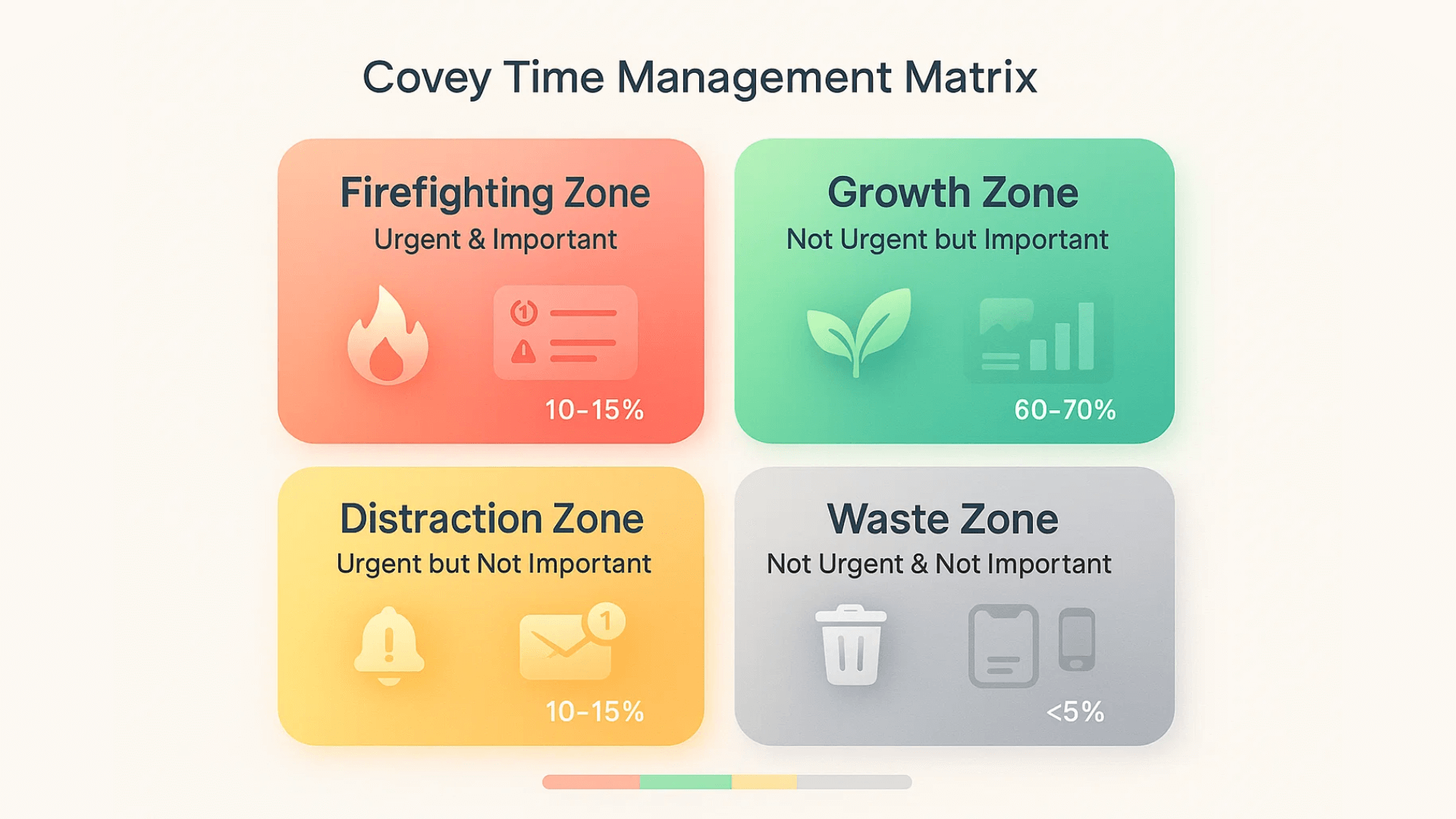
This creates a 2×2 grid with four distinct quadrants:
Quadrant 1 — Urgent & Important
Tasks that require immediate action AND have real consequences.
Quadrant 2 — Not Urgent but Important
Tasks that determine your success, growth, and long-term results.
Quadrant 3 — Urgent but Not Important
Tasks that feel pressing but don’t meaningfully move your goals forward.
Quadrant 4 — Not Urgent & Not Important
Time-wasters, distractions, and non-essential activity.
Covey believed — and research continues to support — that the most effective people spend the majority of their time in Q2, because that’s where future success, clarity, and balance are built.
Why the Covey Matrix Works (Backed by Psychology & Real Experience)
1. It breaks the “urgency addiction” cycle
Most of us live in Q1 because urgency tricks the brain into thinking we’re productive. But constant urgency = constant stress.
Expert insight: Over the years, I’ve seen teams stuck in permanent emergency mode. Once they started prioritizing Q2 work, their output improved while their stress dropped. The work didn’t change — the order did.
2. It forces you to confront your priorities
Most people think they know their priorities. The matrix shows you what you’re actually spending time on — and the difference can be eye-opening.
3. It fights the biggest productivity killer: reactivity
Emails. Slack pings. “Quick calls.” These push you into Q3 before you even realize it.
And it’s not just a feeling — the 2025 Microsoft Work Trend Index shows that the average knowledge worker gets 117 emails per day and faces some form of digital interruption about every two minutes, adding up to nearly 275 pings a day. It’s no surprise most people live in “urgent mode” without ever getting to the work that actually matters.
4. It visualizes your time like a diagnostic tool
Once you map your tasks, the matrix tells you:
- Why you feel overwhelmed
- Why important projects stall
- Why your week doesn’t match your goals
It’s a mirror — and a map.
The Four Quadrants Explained with Examples
Let’s break down each quadrant more deeply, so you can recognize them instantly in your daily work.
Quadrant 1: Urgent & Important — “The Firefighting Zone”
These are high-pressure tasks with deadlines, consequences, and no room for delay.
Typical examples:
- Production issues or bugs affecting customers
- Last-minute project deadlines
- Medical or family emergencies
- Client escalations or crisis calls
- Compliance requirements with legal timelines
Why this quadrant matters:
You can’t avoid Q1 completely. It’s a normal part of life and work.
Signs you’re living in Q1 too often:
- Every task feels like a crisis
- Your team is constantly stressed
- You’re always rushing and never ahead
- You feel reactive instead of strategic
A healthy workflow has Q1 present — but not dominant.
Quadrant 2: Not Urgent but Important — “The Growth Zone”
This is where meaningful, long-term progress happens. This is also the quadrant everyone neglects because it doesn’t scream for attention.
Typical examples:
- Strategic planning
- Upgrading systems or processes
- Training, certifications, self-learning
- Networking and relationship-building
- Health, exercise, mental well-being
- Preventive work (documentation, maintenance)
Thoughtful time tracking also belongs in Q2 when it’s used to understand where your time really goes and make better decisions, not to micromanage every minute.
Why Q2 is the most important quadrant:
- It reduces future crises
- It increases your competence and confidence
- It builds stability in your work and life
- It creates long-term success instead of short-term relief
Most people fail not from lack of effort — but from lack of Q2 time.
A major 2025 systematic review of 107 empirical studies found that effective time management consistently leads to better performance and better wellbeing — lower stress, higher engagement, and stronger long-term outcomes. Q2 isn’t “nice to do”; it’s the evidence-backed foundation of sustainable productivity.
Quadrant 3: Urgent but Not Important — “The Distraction Zone”
These tasks give the illusion of productivity because they’re urgent — but they don’t matter.
Typical examples:
- Interruptions during focused work
- Quick calls and “urgent” requests from others
- Meetings with no agenda or no outcome
- Emails that someone else could handle
- Slack messages that demand instant replies
Warning signs of Q3 overload:
- You keep helping others but your work falls behind
- You respond fast but accomplish little
- You feel busy, yet unsatisfied
This quadrant is where boundaries matter.
Quadrant 4: Not Urgent & Not Important — “The Waste Zone”
These are activities with no meaningful return.
Typical examples:
- Social media scrolling
- Gossip
- Excessive entertainment
- Checking analytics repeatedly
- Busywork done only to look active
These activities are fine in moderation — but deadly in excess.
How to Use the Covey Matrix Step-by-Step
This is where most articles stay vague. Here’s the exact workflow I’ve taught teams and managers for years.
Step 1: Do a complete brain dump
Write down:
- Every task
- Every responsibility
- Every upcoming deadline
- Every idea nagging your mind
This clears your mental workspace and prevents “silent stress.”
Step 2: Sort tasks into the four quadrants
Label each task as Q1, Q2, Q3, or Q4. Don’t try to be perfect — the goal is clarity, not accuracy.
Quick classification tips:
- If ignoring it has real consequences → Q1
- If it improves your future → Q2
- If someone else is pushing it urgently → Q3
- If it adds no value → Q4
Step 3: Build your schedule around Quadrant 2
This is the step that transforms everything.
Block dedicated time each day or week for:
- Learning
- Planning
- Health
- Long-term projects
- High-quality work
A time tracking tool like Karya Keeper can help you see how much time actually goes into Q1 vs Q2, so you can gradually shift more of your week toward important, high-value work. Even 30 minutes of Q2 time per day changes your entire productivity curve.
Step 4: Limit Quadrant 3 with boundaries
Learn to:
- Delegate politely
- Say “not now” without guilt
- Offer alternatives
- Turn off notifications
- Ask clarifying questions before accepting a task
Q3 shrinks dramatically once you realize most “urgent” things aren’t truly urgent.
Step 5: Reduce Quadrant 4 consciously
Q4 is not evil — it’s mindless Q4 that drains you.
Reduce it with simple rules:
- Avoid starting your day with social media
- Create “no-screen” blocks
- Replace Q4 habits with Q2 micro-actions
Step 6: Review the matrix weekly
Life changes, priorities shift, tasks evolve.
A weekly review helps you:
- Realign with your goals
- Identify creeping Q3 activities
- Plan more Q2 time
- Reduce unnecessary commitments
During this review, you can also adjust your time blocking for the next week so that your calendar actually reflects your priorities, not just other people’s urgencies.
Real-Life Examples of Using the Covey Matrix
Let’s make it practical with real-life scenarios.
Example for Professionals (Workplace)
Quadrant 1
- Fixing a production failure
- Urgent client crisis
- Submitting a report due today
Quadrant 2
- Building documentation
- Improving a workflow
- Updating a project roadmap
- Reviewing your time tracking data to spot patterns and bottlenecks
Quadrant 3
- Replying to emails instantly
- Attending meetings without purpose
- Jumping into every Slack message
Quadrant 4
- Random YouTube browsing
- Over-checking KPIs every 10 minutes
Example for Personal Life
Quadrant 1
- Paying overdue bills
- Handling health emergencies
Quadrant 2
- Meal planning
- Exercise & yoga
- Learning a new skill
Quadrant 3
- Family members asking for non-essential help
- Notifications pulling you away
Quadrant 4
- Watching reels for 1 hour unintentionally
Example for Students
Quadrant 1
- Assignments due tonight
- Exam preparations at the last minute
Quadrant 2
- Studying a little every day
- Organizing notes
- Preparing early
Quadrant 3
- Friends asking for “quick favors”
- Club activities not aligned with goals
Quadrant 4
- Binge-watching shows before exams
Common Mistakes & How to Fix Them
Mistake #1: Assuming everything is urgent
Many people tag tasks as Q1 simply because they feel pressure.
Fix:
Ask yourself daily: “If I don’t do this today, does anything actually break?”
Most tasks move from Q1 → Q3 once the fear is removed.
Mistake #2: Spending too much time in Q1
Living in Q1 turns you into a firefighter.
Fix:
Increase Q2 time.
More Q2 → fewer Q1 crises.
Mistake #3: Confusing Q3 tasks as “helping the team”
Helping others is valuable — but not when it sabotages your priorities.
Fix:
Use these phrases:
- “Can we do this later?”
- “Is this truly urgent?”
- “Can someone else help with this?”
Mistake #4: Avoiding Q2 because results aren’t immediate
Q2 feels slow, quiet, and not “productive.”
Fix:
Give yourself micro wins:
- 10 minutes of learning
- 15 minutes of planning
- 20 minutes of deep work
Research found that professionals spend only 12 minutes and 40 seconds on a task before being interrupted — and need an average of 25 minutes to regain full focus afterward. In other words, every small interruption has a hidden cost that compounds over your entire day.
Expert insight: I’ve seen teams burn out simply because they treated Q2 like a luxury. Once Q2 became non-negotiable, morale improved and deadlines stopped slipping.
Who Should Use the Covey Matrix?
This matrix isn’t just for managers — it benefits nearly everyone.
- Managers
To make better decisions, reduce stress, delegate strategically, and avoid burnout. - Entrepreneurs & Founders
To avoid drowning in chaos and focus on growth-driving activities. - Students
To balance deadlines with long-term study habits. - Remote Teams
To avoid constant interruptions and create structured workflows. - Creatives & Knowledge Professionals
To protect focus time for deep thinking and meaningful work. - Anyone Feeling Overwhelmed
If your to-do list never ends, the matrix gives you clarity and control.
Conclusion
The Covey Time Management Matrix isn’t about becoming hyper-productive — it’s about becoming intentional. It helps you slow down, choose wisely, and protect the work that truly shapes your future.
If you take one thing from this guide, let it be this: Master your Q2 time, and your Q1 emergencies will shrink.
And yes — it really can be that simple.
FAQs
A 4-quadrant framework that helps you prioritize tasks by urgency and importance.
Start by identifying your Q2 tasks, block time for them, and avoid Q3 distractions.
Because it focuses on long-term growth, planning, and prevention — reducing stress over time.
Covey’s model adds deeper meaning by focusing on personal values and long-term outcomes.
Urgent but low-value interruptions like “quick questions,” random calls, or unnecessary meetings.
Absolutely — it’s excellent for sprint planning, project alignment, and reducing chaos.
Weekly is ideal; daily work for fast-moving environments.